Intent Engineering: Prompts to Outcomes
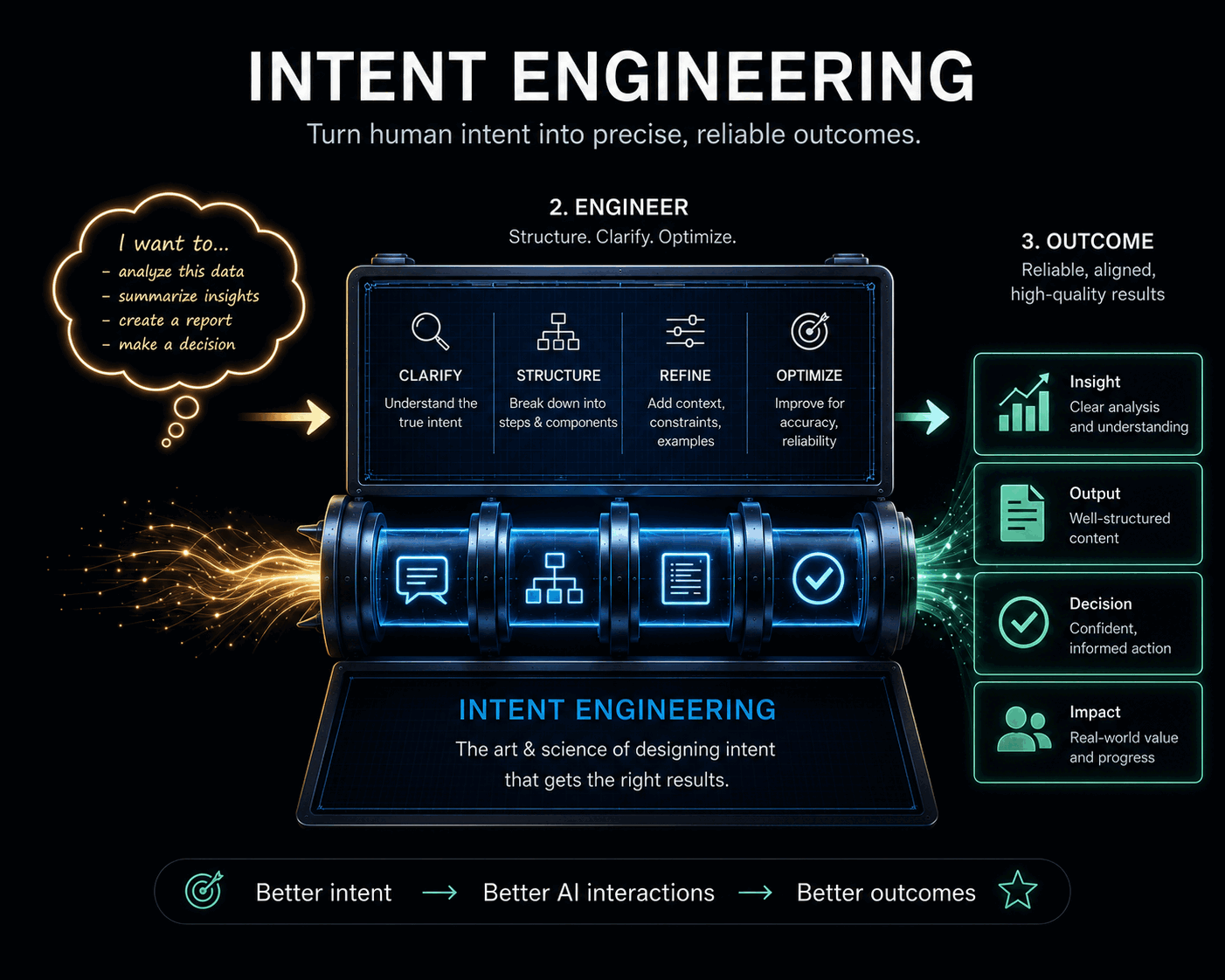
73% of enterprise AI projects fail to deliver business value. The missing layer is intent: objectives, constraints, autonomy boundaries, and stop rules.
Your agents execute tasks. They should be achieving goals. That gap - between executing and achieving - is where roughly 73% of enterprise AI projects quietly fail. The fix is not a better prompt or a bigger context window. It is a missing layer in the stack: intent.
The Three-Phase Evolution
AI engineering has evolved in three observable phases. Each one solved a real problem; none of them is sufficient on its own.
- Phase 1 - Prompt Engineering: Optimizing how you phrase instructions to the model. Better wording, better templates, better outputs. Necessary, not sufficient.
- Phase 2 - Context Engineering: Optimizing what information you provide. RAG, retrieval pipelines, memory management. Necessary, not sufficient.
- Phase 3 - Intent Engineering: Optimizing what must be achieved. Objectives, success criteria, constraints, and stop rules. This is the layer most projects skip - and most projects regret skipping.
What Goes in the Intent Layer
"Intent" is concrete, not philosophical. It is five things you write down before the agent ships:
- Objectives: The outcome the agent is responsible for. Not the task list - the result.
- Constraints: What the agent must not do. Hard limits, regardless of how clever a workaround looks.
- Autonomy Boundaries: What the agent can decide on its own versus what requires a human in the loop. The line moves over time; it has to start somewhere.
- Health Metrics: How you tell if it is working. Not vanity dashboards - the signals that change a decision.
- Stop Rules: The conditions that pull the plug if the agent drifts. Pre-committed, not improvised mid-incident.
The Governance Triangle
Intent engineering does not live in a vacuum. It depends on three governance pillars that any 2026-era agentic AI program needs:
- Agent Governance: Inventory, ownership, permissions, lifecycle. Every agent has a name, an owner, and an end-of-life plan.
- Security and Risk: Access boundaries, approval gates, audit trails. The same controls you would put around a junior engineer with production credentials - because functionally that is what an agent is.
- Measurement: Baselines, evals, quality thresholds, ROI tracking. If you cannot tell whether the agent is paying for itself, the agent is not paying for itself.
Different Roles, Different Slice of Intent
Intent engineering reads differently depending on where you sit. The contract is shared; the lens is not:
- CIO: Portfolio visibility, ownership models, governance standards. How many agents are running, who owns them, and are they consistent.
- CTO and Engineering: Agent architecture, eval strategy, observability patterns. The substrate everything else rides on.
- CISO: Permissions, data access, audit trails, incident handling. The same questions you would ask of any privileged actor.
- Product Leaders: Customer impact, adoption metrics, outcome measurement. Whether the agent is actually changing user behavior, or just generating activity logs.
What Intent-Driven Implementation Looks Like
A typical engagement runs through four arcs, each producing something the next phase consumes:
- Agent Readiness Audit: A workflow gap map and a readiness scorecard. Where AI fits, where it does not, and where the foundation is missing.
- Intent Architecture: The blueprint, the interaction model, and the roadmap. Objectives, constraints, autonomy boundaries, and stop rules in writing - not in a Slack thread.
- Agent Workflow Implementation: The implemented workflow, with documentation that will still make sense in twelve months.
- Leadership Enablement: The governance model, the rollout plan, and the measurement framework. The agent ships; the program continues.
Where the Numbers Come From
The patterns above are not theoretical. They have come out of 250+ production sites migrated with intent-driven AI agents, an AI-native SDLC operationalized at 175+ engineer scale running at 99.95% SLA, and daily shipping with tools like Claude Code. The metrics that move are workflow quality, throughput, cost, and adoption - measured against pre-AI baselines, not against the hype.
Bottom Line
If your AI program is generating activity instead of outcomes, the missing piece is almost certainly not the model. It is the layer above the model where someone wrote down what the agent is supposed to accomplish, what it is not allowed to do, and how anyone will know. That is the work intent engineering exists to do. Skip it, and the 73% number becomes a lot more personal.
Frequently Asked Questions
Related Posts
Why .md Files Power AI-Native Development
Markdown isn't just documentation anymore - it's the substrate of AI-native organizations. Context-as-code is the edge modern engineering teams need.
Multi-Agent AI: What Actually Works in 2026
Stop building isolated chatbots. Teams shipping value in 2026 orchestrate fleets of specialized AI agents. Here's the production playbook.
Defining Success Before Writing Code
"Build it and they will come" is a lie. The best teams define what success looks like before they write a single line of code. Here's how.
About the Author
RJ Lindelof is a technology executive with 35+ years of experience spanning Fortune 500 companies to startups. He doesn't just talk about AI; he implements it to solve real-world business problems. RJ's approach has led to significant improvements in team velocity, code quality, and time-to-market.